Fentress Architects is proud to announce that the Miami Beach Convention Center Expansion and Renovation has won the 2020 BESTaward in the Serve category from the International Interior Design Association (IIDA) Rocky Mountain Chapter! As a leading interior design excellence awards program, the BESTawards recognizes projects that truly encompass “Brilliantly Executed Spaces and Thinking.”
Located in the heart of the city, the 1950s Miami Beach Convention Center (MBCC) needed a transformation befitting its reputation as a world-class entertainment destination the venue has become known for through annual events such as Art Basel and eMERGE Americas. To create a design that is quintessentially South Florida, we explored the surrounding culture and context, allowing for the design to become a contextual representation of the city.
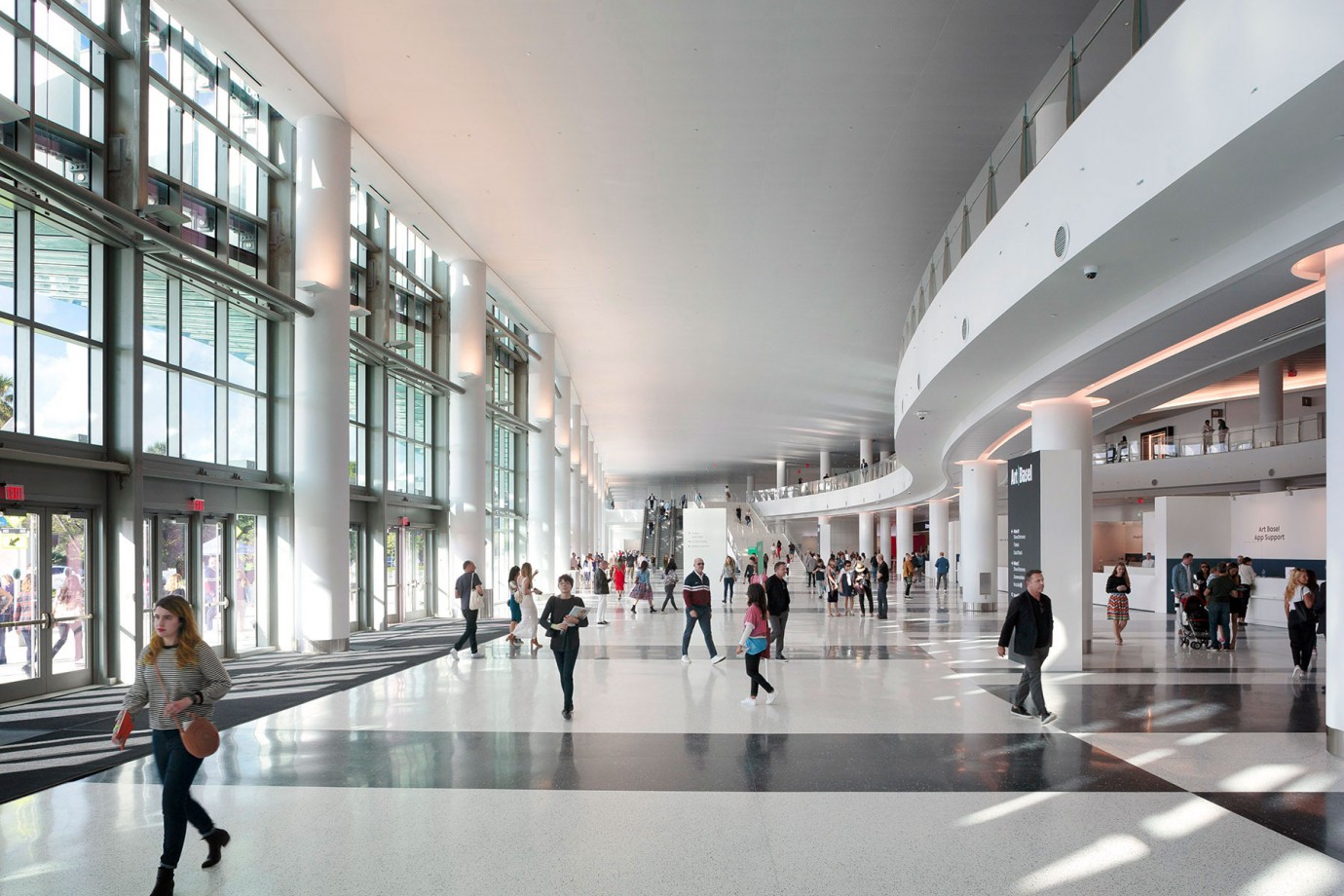
One of the greatest challenges was harmonizing the 1.4 million-square-foot, grand scale building with the intimacy of human scale to create flexible, intuitive and daylit spaces. Inspired by the undulating ocean waves, the exterior façades’ “fins” – angled aluminum linear forms – filter dappled light throughout the daylit lobbies and pre-function spaces to provide a seamless transition between indoor and outdoor environments. This contextual inspiration was brought inside with colors and patterns that emulate receding water, sea foam, and local coral reef patterns.
“The finish palette is extremely thoughtful in regards to the surrounding nature while not going too over the top.” — 2020 BESTawards Jury
To truly capture the essence of Miami Beach in the design, we carefully studied how light enters the surface of water, as well as how it appears underwater from a diver’s perspective. This experience is celebrated in the entries leading into the event spaces, where portals with beacons of light intuitively guide visitors into the room. We also translated satellite images of nearby ocean waves, coral and sandbars into custom patterns for the carpets throughout pre-function and public circulation areas. Lighting fixtures were selected to create an uplifting, yet serene atmosphere reminiscent of the ocean.
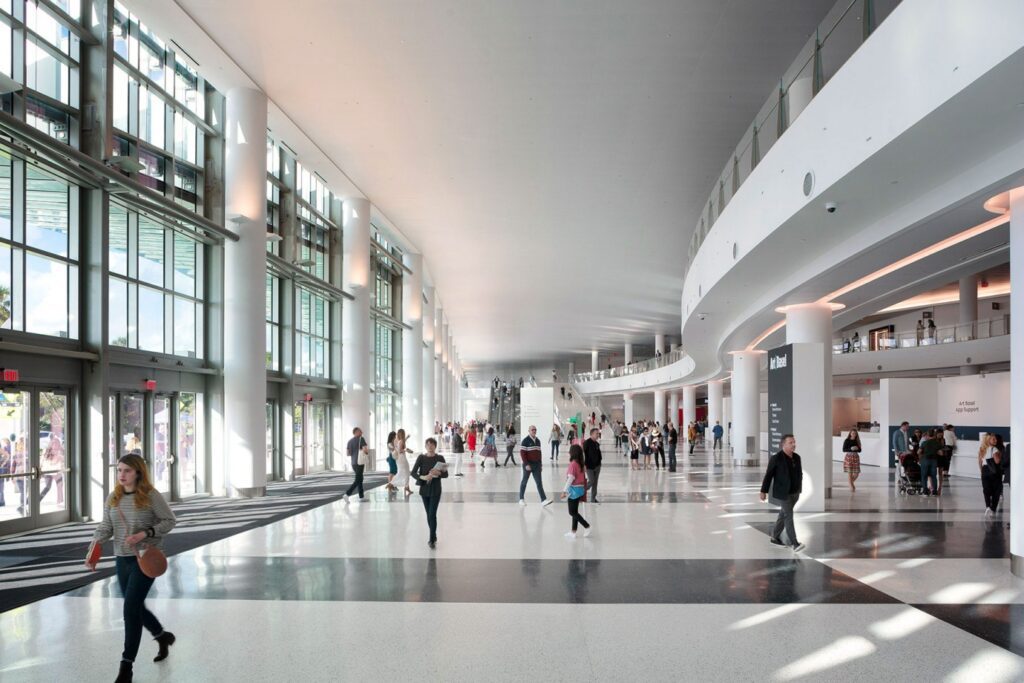
Natural light, glistening white columns, and subdued lighting punctuate the pre-function lobbies.
Swooping curves, glistening white columns, and subdued lighting punctuate the pre-function lobbies and the 60,000-square-foot Grand Ballroom, drawing inspiration from Miami’s modernist architecture. The new Grand Ballroom features acoustic sound panels to heighten sound quality and LED lighting to produce both high-quality lighting and energy savings.
Surrounded by natural light and modern glass paneling, the Grand Ballroom’s 18,000-square-foot pre-function space overlooks contemporary artwork installed by Miami Beach’s Art in Public Places. Within this environment, MBCC visitors and staff experience digital displays incorporating event-specific branding, art and dynamic visual elements.
Watch the IIDA RMC 2020 BESTawards Virtual Event and learn more about this year’s winners here.
Fentress Architects, a global design firm specializing in the creation of memorable public architecture, is excited to announce that the redesigned Miami Beach Convention Center (MBCC) recently achieved LEED Silver certification from the United States Green Building Council (USGBC), marking a significant achievement in realizing the City of Miami Beach’s sustainability standards. Completed earlier this year, the 1.435 million-square-foot redesign included an expansion and renovation of the existing 1950s-era center to accommodate upgraded show needs while creating a sleek, modern and regionally inspired design befitting MBCC’s reputation as a world-class entertainment destination. The venue has become internationally known for hosting annual events such as Art Basel Miami Beach and eMERGE Americas.
“The Miami Beach Convention Center’s LEED Silver certification exemplifies the significant coordination, innovation and green building leadership that was demonstrated among the entire project team,” said Deborah Lucking, AIA, LEED AP BD+C, Director of Sustainability at Fentress Architects. “This project stands as a testament of resilient, sustainable and forward-thinking design that will serve as a commitment to the community now and well into the future.”
Context-driven design
Located in the heart of Miami Beach, Florida, MBCC’s design realizes the City of Miami Beach’s vision to reposition the center as one of the most technologically advanced convention centers in the U.S. while enhancing the facility to comply with FEMA code as part of a resiliency plan to safeguard against future hurricanes and flooding. To create a design that reflects the city’s vibrant culture and natural environment, the design team immersed themselves in the landscape and lifestyle of Miami’s South Beach.
Fentress collaborated with Arquitectonica on the context-driven design to incorporate natural elements of the ocean, beach and underwater life such as waves, manta rays, and coral reefs. The exterior façade is designed with over 500 unique aluminum “fins” – angled aluminum linear forms – to create a curving undulation reflective of the nearby ocean waves. This contextual inspiration was brought inside with colors and patterns that emulate receding water, sea foam, and local coral reef patterns. The team also translated satellite images of nearby ocean waves, coral and sandbars into custom patterns for the carpets throughout pre-function and public circulation areas.
“This exciting milestone for the MBCC represents the culmination of a long journey, demonstrating the MBCC’s serious commitment to resiliency and sustainability,” said Freddie Peterson, General Manager at the Miami Beach Convention Center.
Site responsive architecture
The façades’ angled fins create a curtain wall that responds to the solar orientation of each façade, filtering dappled light throughout the daylit lobbies and pre-function spaces to provide a seamless transition between indoor and outdoor environments. Hurricane-resistant connections and projectile resistant glazing on the exterior façade establish a strong and stable building envelope. Additionally, the elevation of critical building systems to the second floor allows the building to remain operational during hurricanes while raised floor elevations respond to rising sea levels.
Creating a resilient community amenity
In collaboration with West8, Fentress Architects transformed the existing six-acre surface parking lot into a vibrant public park – a key element of the project’s resilient design that includes a tropical garden, game lawn, shaded areas, and veterans’ plaza. Additionally, Bent Pool, a public art installation by international artists Elmgreen & Dragset celebrates Miami Beach’s dynamic culture and natural environment. In total, the design team added twelve acres of greenspace, preserved more than 100 existing trees, and added over 1,300 new trees. As a result, the design increases the pervious acreage of the 25-acre campus by 245% and significantly reduces heat island effect. The project is designed to a 25-year, 3-day storm event as the maximum stage for site drainage retention.
Prestigious Award Heralds the Government Center an “Architectural Gem”
The American Institute of Architects (AIA) Western Mountain Region (WMR) chapter has honored the Clark County Government Center, designed by Fentress Architects, with its 2020 Twenty-five Year Award. This prestigious award recognizes a built structure that has significantly influenced design and lifestyle in the Western Mountain Region. The project’s Southern Nevada-inspired design was recognized during the AIA Western Mountain Region Design and Honor Awards virtual Gala on Thursday, October 1, 2020.
“In a town where icons are normally casinos and themed campuses, this project is refreshing because it has brought a conversation of architecture to the public consistently. We are really pleased to see that the community has embraced the project wholeheartedly.” — 2020 AIA WMR Honor Awards Jury
Following a national design competition with submissions from 45 architects—including Antoine Predock and Venturi, Scott Brown and Associates—Fentress Architects was selected to design the Government Center. Fentress completed the project in June 1995 with a mission to provide the county with a much-needed seat of government that would also serve as the heart of this rapidly growing Nevada community for years to come. Today, more than 25 years later, the 375,000-square-foot, six-story Government Center continues to stand as one of Southern Nevada’s most memorable architectural landmarks, highlighted in nearly 20 awards and distinctions such as “Best of Las Vegas, Best Non-Hotel Architecture” for eight consecutive years (1999-2005) by readers of the Las Vegas Review-Journal.
“At Fentress, we believe architecture should serve a longstanding commitment to the community,” said Curtis Fentress, FAIA, RIBA, Principal in Charge of Design at Fentress Architects. “This award is not only a testament to our humanistic design approach, but to years of collaboration with Clark County officials and community members. The Clark County Government Center has created an enduring landmark for the region while showcasing a model of open, accessible and stable government.”
Design for People
Every detail of Fentress’ design—from the spatial organization and design of the commission chambers, to form and materiality—harmonizes to create an uplifting, human-centric experience. The firm’s approach embodies four main themes: realize a civic order through logical, functional and straightforward design; establish a sense of place; create a concept of open an accessible government; and conceive a stable, permanent, and valued image of county government.
The government center is organized around a multifunctional County Courtyard and shaded arcade, facilitating intuitive wayfinding while protecting visitors from the desert sun as they navigate the complex. Natural stone forms and trees complete the circular layout and define an outdoor amphitheater for special events, concerts, and ceremonies. Inside the Commission Chambers, the County Commissioners’ seats are recessed, placing the citizens of Clark County above the officials and symbolizing a government of the people.
Creating Meaning, Identity and Sense of Place
The design considers landscape an essential source for connecting architecture with community and the region’s history. Seeking to emulate Nevada’s native landscapes found at Red Rock Canyon and Valley of Fire, Fentress’ team visited the sites, borrowing inspiration from the dramatic surrounding desert environment including sandstone walls, unexpected openings and details, and geometric shapes.
These compelling references to Nevada’s history and natural landscape can be explored throughout the Government Center’s architecture. For example, the tree-lined pedestrian spine leading into the building represents the pathway to Mouse’s Tank at Valley of Fire, while petroglyphs chiseled in the shaded arcade illustrate actual sandstone carvings engraved by Native Americans throughout Southern Nevada. Inside the kiva-shaped County Room, the 80-foot diameter and 100-foot-high rotunda features a form and materiality inspired by the stream-worn basin of Mouse’s Tank. The pyramidal structure housing the 400-seat cafeteria and Community Room reflects the nearby Lone Mountain, and the triangular clerestories inside the Commission Chambers evoke the Prickly Pear cactus.
Connecting Architecture with Community
Clark County Government Center is not only an institution, but an amenity for the community. Each year, the amphitheater hosts diverse events ranging from cultural festivals and weddings, to regional traditions such as the annual Jazz in the Park series. A specially created docent program provides architectural tours to meet community demand to engage deeper with the building, the art events it hosts, and its many unique features. In fact, the building was a selected site tour at the AIA Conference on Architecture 2019. The Government Center showcases that the built environment can embrace, connect, and inspire its community—a true indication of the government center’s enduring significance in the Western Mountain Region.
2020 Fentress Global Challenge Entry. Team: Schiphol International, Amsterdam Schiphol Airport, North Carolina State University.
Fentress Architects is excited to announce 22 entries have been shortlisted for the 2020 Fentress Global Challenge (FGC), which garnered more than 100 entries from students in over 15 countries. FGC is an annual international student design competition launched in 2011 by Curtis Fentress, FAIA, RIBA that encourages and rewards innovative design in public architecture. This year’s competition challenged students to envision airport mobility in the year 2100.
“Each year I am ever more impressed by the vision, creativity, and practicality set forth by these young architects,” said Curtis Fentress who is also Principal in Charge of Design at Fentress Architects. “This year’s shortlist couldn’t be more diverse; they range from a modular floating terminal to a self-growing airport integrated into the site’s ecosystem. Each concept pioneers creativity, advances innovation and recognizes real solutions that would enhance the passenger experience of 2100.”
Of the over 100 entries judged last month by a panel of architects and designers at Fentress Architects, most explored one of the following areas: Futuristic Mobility, Mitigation of COVID-19 and Zero-Emission.
Futuristic Mobility
Flying air pods carry passengers and their baggage to and from their home. Team: CGC, HK22, Harvard Graduate School of Design.
Several submissions built upon recent developments in futuristic transportation—from the Hyperloop to autonomous vehicles—to imagine the airport of the future as a multimodal hub equipped to handle next-generation aircraft, space travel, autonomous transportation, integration of the hyperloop, and even autonomous pods. Concepts ranged from terminals with launchpads for spaceflight and underground Hyperloop connections to the replacement of aircraft with self-flying autonomous pods.
Mitigating COVID-19
This concept reimagines Heathrow International Airport as a “healing hub” that monitors and treats disease carriers. Team: S.T., Heathrow Healing Hub, Tel-Aviv University.
The current pandemic inspired a wide range of ideas on how airport design might help mitigate the spread of COVID-19 and other infectious diseases, which may be more prevalent in 2100. Fully touchless airports as well as terminals that dual function as “healing hubs” were among the concepts that sought to create health-centric, comfortable, and efficient travel experiences.
Zero-Emission Airports
The Green Gateway transforms Indira Gandhi International Airport into a zero-mission, sustainable airport. Team: BANIYA, The Green Gateway, Southern California Institute of Architecture.
A number of submissions utilized cutting-edge solutions as a means to develop zero-emission airport facilities. Among the forward-thinking ideas submitted were airports that integrate with the surrounding ecosystem; terminals reimagined as greenhouses; and decentralized air purifying towers.
The 22 contestants will be judged virtually by a jury of renowned airport architects, directors, planners, and scholars. Winners will be announced in October.
The 2020 Shortlist:
W.A.D, Floating Aero City – Hong Kong International Airport, Beijing Jiaotong University, Beijing, China
Arch YiYang, The Vertebrae – Singapore Changi Airport, University of Malaya, Kuala Lumpur, Malaysia
BANIYA, The Green Gateway – Indira Gandhi International Airport, Southern California Institute of Architecture (SCI-Arch), Los Angeles, California, USA
Ajay Kamaleshwaran, CornUcopia – Indira Gandhi International Airport, Anna University School of Architecture and Planning, Chennai, India
TIArch Studio, The Reserve – Indira Gandhi International Airport, Kazan State University of Architecture and Engineering, TIArch Studio, Kazan, Russia
Qianqian YU, ReBABEL – Hong Kong International Airport, Special School of Architecture (École Spéciale d’Architecture), Paris, France
Beyond Heathrow, A New Airport for London – Heathrow Airport, The Barlett – University College London, London, England
Schiphol International, Amsterdam Schiphol Airport, North Carolina State University, Raleigh, North Carolina, USA
ISM, Resonance of the Antiquity – Indira Gandhi International Airport, Bangladesh University of Engineering and Technology, Dhaka, Bangladesh
Lucy Janik, LAX Airport Relocation – Los Angeles International Airport, Cracow University of Technology, Kraków, Poland
Qian Lin and Umica Yelavarthy, Shanghai Pudong International Airport of the Future, North Carolina State University, Raleigh, North Carolina, USA
Henry Alridge, A Built-In Obsolescence – Jakarta Soekarno-Hatta International Airport, University of Cambridge, Cambridge, England
CGC, HK22 – Hong Kong International Airport, Harvard Graduate School of Design, Cambridge, Massachusetts, USA
CRAB, Shanghai Pudong International Airport, University of Toronto, Toronto, Canada
PRAXIS, Modular Floating Airport, Singapore University of Technology & Design, Singapore
RIE, O’Pon on the Hill, Yogyakarta University of Technology, Sleman, Daerah Istimewa Yogyakarta, Indonesia
Sejkul, Drive-In Airport 2100 – Hartsfield-Jackson Atlanta International Airport, University of Ljubljana, Faculty of Architecture, Ljubljana, Slovenia
Ryerson University, Head in the Clouds, Ryerson University, Toronto, Canada
Marklin Huynh, Istanbul International Airport Asian Terminal, North Carolina State University, Raleigh, North Carolina, USA
M3DMA, Tokyo Gate – Tokyo International (Haneda) Airport, Gdansk University of Technology, Gdańsk, Poland
Oporajeyo, The City Lungs – Indira Gandhi International Airport, North South University, Dhaka, Bangladesh
The shortlist will be judged virtually by a jury of renowned airport architects, directors, planners, and scholars. Winners will be announced in October.
Global architectural design firm Fentress Architects and Johnson County Board of Commissioners recently announced the substantial completion for the new Johnson County Courthouse, prominently located at 150 W. Santa Fe St. in downtown Olathe, Kansas.
The seven-story, 356,831-square-foot courthouse, designed by Fentress Architects in a partnership with Treanor HL, and constructed by JE Dunn Construction, replaces the aging, overcrowded existing courthouse by consolidating the Tenth Judicial District Court, District Attorney and supporting spaces into a distinctive civic building. The new state-of-the-art facility includes 28 courtrooms, flexible space for six additional courtrooms and supporting functions including a Law Library, Court Administration, Court Clerk, Help Center, Court Trustee, Justice Information Management, Sheriff’s Office and other services necessary to serve all judicial and administrative needs for the Johnson County community.
“This milestone represents a significant accomplishment in realizing Johnson County’s vision for a more efficient, community-oriented and forward-thinking courthouse,” said Brian Chaffee, FAIA, Principal at Fentress Architects. “The courthouse’s design celebrates Johnson County’s historical roots while embodying its innovative vision with a memorable structure that will serve as a longstanding commitment to the community. We are looking forward to continue working with the County, Treanor HL and JE Dunn Construction as we realize the project’s final completion.”
Designed to USGBC LEED Gold with principles as delineated by the WELL Building Institute, the new courthouse will serve Johnson County for the next 75 years, accommodate the expected growth of 10,000 residents per year and fulfill the County’s goal to reduce energy by 30 percent. The open and accessible design harmonizes with traditional federal architectural features to create an approachable, yet efficient facility that reflects the importance of justice and the Rule of Law.
Inspired by materials and forms found in Kansas geology and history, the courthouse’s prominent façade features a limestone-clad ribbon wall above the main entry, creating both a sense of place and a welcoming entrance. The “Emporium of Justice” serves as the courthouse’s main lobby where visitors enter and pass through security. An expansive glass curtainwall and punched windows advance the transparency in government functions. Additional features including terrazzo floors, glass handrails, acoustical plaster ceilings and custom millwork contribute to the courthouse’s durability and monumental image.
“The new courthouse creates a functional, accessible, safe and secure facility that will serve the long-term needs of the Johnson County community,” said Daniel Wehmueller, Project Manager at Johnson County. The building’s distinct design has already become a Johnson County landmark. We couldn’t be happier with the project team’s innovative and creative approach that has helped the County bring this vision to life.”
Public art funded by Johnson County’s Public Art Program creates an engaging, one-of-a-kind courthouse experience. “Open Prairie,” a public art piece installed by Los Angeles-based Ball-Nogues studio, integrates seamlessly into the building’s design and creates a network of vibrant colors as visitors enter the courthouse. Additionally, Goddess of Justice has been relocated from the existing courthouse to the new facility.
In addition to the new Johnson County Courthouse, the project team developed the north parking lot. To create a resilient amenity for the community, the project team will transform the existing courthouse site into a new greenspace for the community.
The team is currently installing systems and ancillary furniture, which will continue through November. Johnson County staff will begin occupying the courthouse in September, and the building is intended to open to the public in the first quarter of 2021.
On Friday, July 17, the first Southwest Airlines flight took off from the new Concourse D at Nashville International Airport (BNA). Delivered by the Hensel Phelps | Fentress Architects Progressive Design-Build Team, the 115,000-square-foot expansion signifies a major milestone for BNA Vision – a dynamic expansion and renovation plan aimed at maintaining the airport’s status as a world-class facility to keep pace with the airport’s record-breaking passenger volumes and projected growth.
The new concourse is a key element of the $292 million, 315,000-square-foot Concourse D and Terminal Wings Expansion project. It will significantly enhance the passenger experience as the airport continues to bring BNA Vision to reality. As Concourse D opens, Hensel Phelps and Fentress Architects are at work on another major project at BNA: a substantial terminal lobby renovation and state-of-the-art International Arrivals Facility, will be completed in late 2023.
“The new Concourse D elevates the passenger experience as a state-of-the-art facility with modern finishes that will delight travelers as they come and go at BNA,” said Curtis Fentress, FAIA, RIBA, Principal in Charge of Design at Fentress Architects. “The flexible design allows the airport to accommodate future growth, passenger needs, evolving technology and aviation trends, all while creating a modern gateway befitting Nashville’s world-class prominence. We’re excited to continue working with the Metropolitan Nashville Airport Authority and Hensel Phelps to bring the BNA Vision to life.”
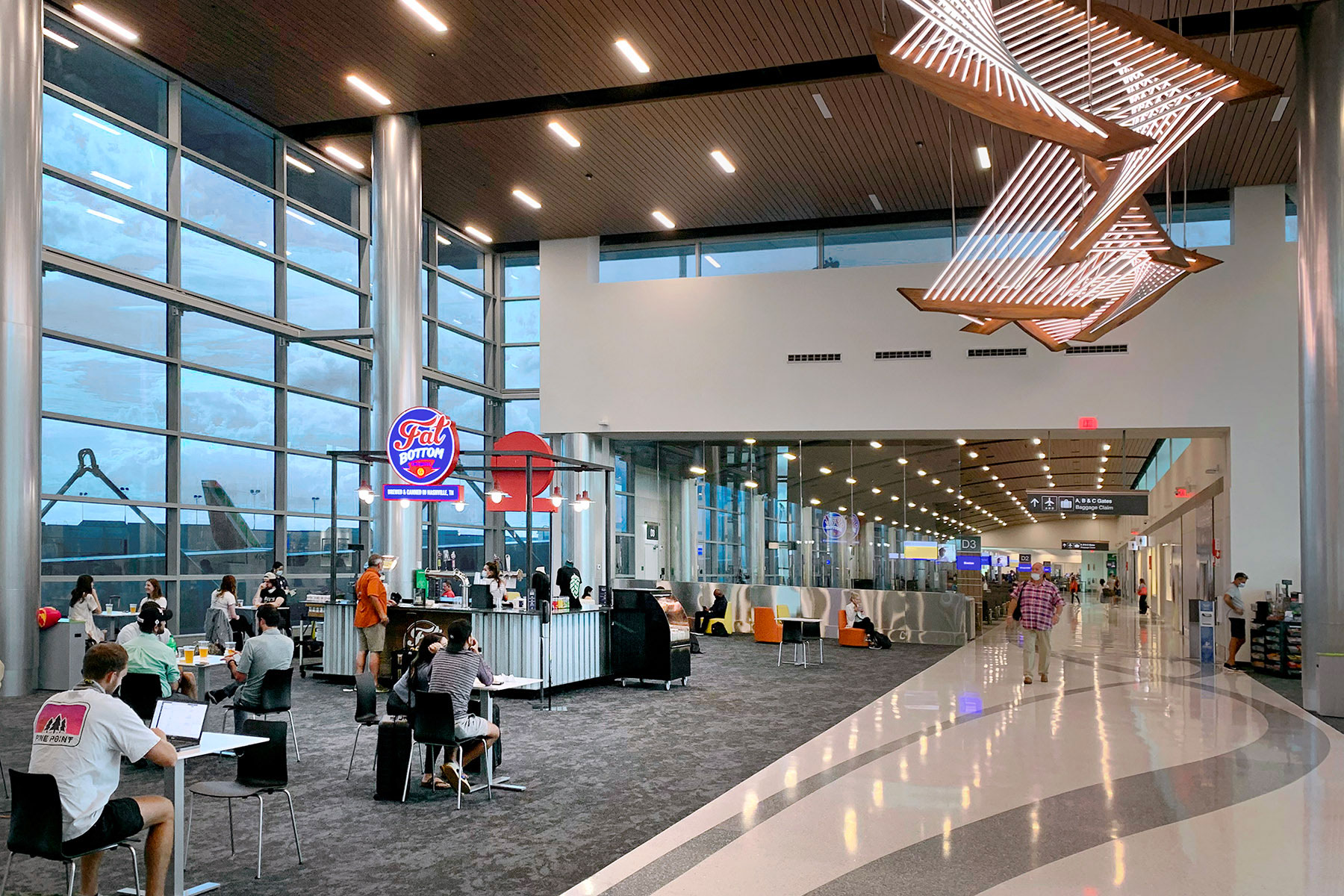
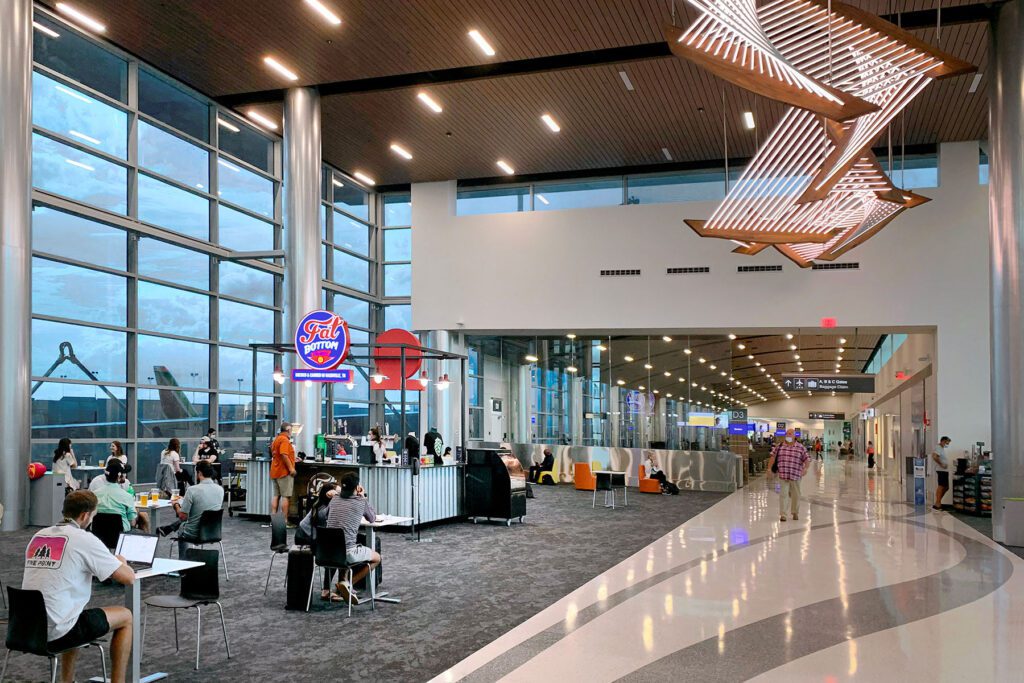
The 115,000-square-foot expansion of Concourse D adds six new domestic aircraft gates, public art, and a variety of traveler amenities, along with improved ramp amenities and function space. Additional components of the project include a 136,000-square-foot renovation of existing terminal space and a new 11,000-square-foot Central Utility Plant to heat and cool the terminal.
“The new Concourse D gives us more capacity for commercial air service to meet the rising demand for travel to and from Nashville,” said Doug Kreulen, MNAA president and CEO. “At the same time, it’s an impressive, energy efficient structure reflective of the world-class airport that is taking shape. BNA Vision is an exciting series of projects, and there’s much more to come. We are proud to serve Nashville and Middle Tennessee.”
This fall, the team will complete BNA’s 200,000-square-foot North and South Terminal Wings Expansions, providing for interim TSA checkpoints, permanent ticketing check-in counters, baggage claim devices and support offices.
In response to coronavirus (COVID-19), the project team implemented safety and social distancing protocols in line with CDC guidelines to strengthen the wellbeing of both project team members and passengers while creating a safe and healthy airport experience. Developing an adaptive and agile response, the team delivered Concourse D on time.
At Fentress Architects we follow our Eight Touchstones of Design. Our eighth, and most important pillar, is “Design for People”—meaning everyone.
Truly great architecture transcends time and space. It shows genuine respect for the environment, for people, and for the universe. It is, in short, about design that elevates and restores.
In concert with the National Organization of Minority Architects’ (NOMA) Public Statement Regarding Racial Injustice, we stand strong with our fellow Americans, particularly Black Americans, in the condemnation of racism, and we are taking an active role toward eliminating the racial biases that account for a myriad of social, economic, and health disparities.
We commit to education and actionable measures.
We strive to make Fentress Architects a more equitable, diverse, and inclusive studio. Our thoughts and prayers are with all who are suffering in this time.
In fiscal year 2019, Congress approved funding for the construction of a new approximately 123,100-gross-square-foot federal courthouse in Huntsville, Alabama, for the U.S. District Court, Northern District of Alabama. Fentress Architects was appointed as the Lead Design Architect with Payne Design Group as the Bridging Architect for the project in February 2020.
The new courthouse will include five courtrooms and six judges’ chambers and will provide workspace for several other federal agencies, including the U.S. Marshals Service, the U.S. Attorney’s Office, and the U.S Probation and Pretrial Services. Once built, the courthouse will have 26 secured parking spaces.
Project Details
Total authorized funding: $86.4 million for site acquisition, design and construction services. Project delivery method: Design-Build Bridging Lead design architect: Steve White, Fentress Architects
Fentress Architects is proud to announce the winners of the 2019 Fentress Global Challenge, its seventh edition of the international student competition representing the firm’s commitment to the advancement of innovative design in public architecture. This year’s challenge was to envision the Airport of the Future in the year 2075.
Exceeding 500 registrations, the competition drew students from more than 50 countries. In the spirit and innovative nature of design competitions, participants sought to improve every aspect of the airport passenger terminal building, delving deeply into one or more highly relevant area in airport architecture and the future of aviation: mobility, urbanization, globalization, technology, flexibility, security, project feasibility, and passenger experience.
The three winning proposals reflect bold conceptual thinking, acute sensitivity to context, and skilled design. The first-place prize is USD$10,000 and the opportunity to receive the award from Curt Fentress at a prestigious architectural event. Second place will receive USD$3,000, third place USD$2,000, and the two People’s Choice Awards will receive USD$1,000.
Members of the Jury
Curtis Fentress, FAIA, RIBA, Principal in Charge of Design at Fentress Architects
Thomas Pellegrin, Head of Consulting – Asia & Middle East, IATA
Christine Negroni, air safety specialist, journalist, and author of The Crash Detectives
Charles Waldheim, Director, Office of Urbanization at the Harvard University School of Design
Ken Gidlow, Technical Advisor, FAA at the NASA Johnson Space Center
Dr. David Alexander, Professor of Physics and Astronomy at the Rice Space Institute
Bryant L. Francis, C.M., Director of Aviation at the Port of Oakland
Khaled Naja, Executive Vice President of Airport Development and Planning, Dallas Fort Worth International Airport
2019 FENTRESS GLOBAL CHALLENGE WINNERS
1st Place – Infinity AirportWinner: Daoru Wang, North Carolina State University, Raleigh, NC, USA
To improve the efficiency of the airport typology, this project underwent an intensive study of aircraft traffic flow and further developed the concept of a ‘drive-through airport.’ Just as important as the internal operations, the connection to the existing urban fabric ensures that the design is not only efficient but also celebrated and utilized properly. Taking inspiration from the torus knot, which appears like two overlapping INFINITY symbols, the general shape of the airport combines the complexity of the form and the ideology of INFINITY by creating the circular and endless concourse system. At the same time, the double-loaded bar system has the capability to stream the loading/unloading process, which underlines the importance of the circulation of the aircraft within the airport and expands the limits of the typology of existing airport.”– Daoru Wang
2nd Place – Newark Airport Biophilic Headhouse and Community NexusWinner: Samantha Pires, New Jersey Institute of Technology, Newark, NJ, USA
“The project uses this rail access and a consolidated terminal to explore ideas defined by economic analyst John Kasarda, [author of] the Aerotropolis. The aerotropolis is a conceptual type of urban form, with the airport as the center of the metropolis. This project applies the concept of the aerotropolis and proposes that the Airport of the Future is one that brings economic development to the community that it serves. It proposes that the Airport of the Future should not be governed by fear and ‘security theater’ that runs modern airports, but that it should be a place for community engagement, job opportunities and a catalyst for neighborhood development and benefit.” – Samantha Pires
3rd Place – LondonHeathrow2075Winner: Christopher Johnson, University for the Creative Arts, Farnham, UK
“A new airport concept typology explores future technological trends and smart cities to connect humanity directly to generate a new urban fabric within the existing airport landmass of Heathrow. A drive-through concept that sits below the airport terminal allows aircraft traffic and waiting times to be reduced. Technological innovations suggest a reduction in physical passports, security and immigration as it moves to an online environment. An international zone that lives within a country that provides free roam to visitors and guests creates a global destination that re-invests in the notion of the UK’s stance on the global market.” – Christopher Johnson
PEOPLE’S CHOICE
The 2019 People’s Choice Awards garnered extraordinary attention on Fentress Architects’ Facebook page, reaching hundreds of thousands of people organically. Shortlisted participants ran their own social media marketing campaigns to generate thousands of likes.
#1 People’s Choice Award – Y3M with 2,800+ Votes on Social MediaChai Yi Yang and Ng Yi Ming, University of Malaya, Kuala Lumpur, Malaysia
“We envision the possibility of a synthetic amalgamation—the integration of an Elon Musk-like Hyperloop tube system and capsule fuselage technology. The great leap in technology advancement would manifest a subversive paradigm transformation towards current airport morphology, from a centralized mass into a vessel-like network. While refraining the inefficiency of turnaround, vast runways, long travel distance, huge labor force, convoluted programming and so on, the new model suggests a seamless transition from rail to flight—elementary yet expeditious. This gesture is denying the airport as an isolated system in the collective locomotion structure, bringing aviation closer to our regular transit as a unification where we expect a new civic role. This notion adopts the ideology of Hong Kong as a capital of movement and efficiency, being a creation of international identity. The other part of this concept advocates ecological concern to reserve a greater land compared to traditional typology.”– Chai Yi Yang and Ng Yi Ming
#2 People’s Choice Award – Six Lane City with 2,500+ Votes on Social Media Riki Rozenberg, Evelyn Kreslavsky, Mai Whiteson, Tel Aviv University, Tel Aviv, Israel
“Today, O’Hare International Airport in Chicago extends over 12 square miles, most of which are not fully exploited. Therefore, we decided to create a new form of city, 650 feet above ground level, which will be built on top of the existing lanes or runways of the airfield. Our goal is to create an aerotropolis—an airport which integrates residential solutions, economic opportunities and cultural experiences, which, we think, will bring people closer together.” – Riki Rozenberg, Evelyn Kreslavsky, and Mai Whiteson
“Each year the Fentress Global Challenge captures the creativity of young talent as contestants conceive innovative design ideas that create a better physical environment for our future world. The critical thinking and quality of ideas presented in this year’s competition were no exception; the entries were absolutely stunning.”
Registration has opened for the 2020 edition of the Fentress Global Challenge at www.fentressglobalchallenge.com. Guidelines will be announced by October 2019.
Annual Design Competition calls on Students to Imagine the Future of Airports
Fentress Architects is proud to announce the shortlisted entries for the 2019 Fentress Global Challenge:
AER-O75
Arseniy Rabotnov Architects
Boom
Cargo
CJ Studio
FP
Hong Kong International Transit Terminal
Infinity Airport
MSY
Niasinn
Samantha Pires
Sharygina_Ekaterina
Six Lane City
Vi and Del
Y3M
Yuanyuan Wu
The shortlisted entries include a wide range of responses—from highly speculative visions, to more practical adaptations of current methodologies.
Participants were challenged to re-envision the terminal building for the year 2075 and in doing so, also integrate a key component of Fentress’ design philosophy: use context to create identity. They were cautioned that context is more than an intellectual consideration of the history, or physical appearance of a place, and more than the way new will live with old. Context must draw on the senses and memories that define a place and make it unique. Context grows from community, and people respond to it.
In line with the speculative nature of the competition, participants were also challenged to improve every aspect of the airport terminal building, and to delve deeply into one or more highly relevant areas in airport architecture and the future of aviation: mobility, urbanization, globalization, technology, flexibility, security, project feasibility, and passenger experience.
Curtis Fentress, founder of the Fentress Global Challenge, said “there was no shortage of creativity this year; we saw several interesting ideas that incorporated hyperloop, driverless cars, pod systems, vertical structures, new security systems, and even space travel.”
Between now and July 29, the public is encouraged to vote for FGC’s “People’s Choice Award” winners by liking their favorite entry at Fentress Architects’ Facebook page: www.facebook.com/FentressArch/.
First place will receive US$10,000 cash and the opportunity to attend a prestigious, architectural event. Second and third places awards are also cash prizes.
The jury is comprised of aviation experts and industry professionals:
Curtis Fentress, Founder of Fentress Global Challenge and Principal in Charge of Design, Fentress Architects
Thomas Pellegrin, Head of Consulting – Asia & Middle East, International Air Transport Association (IATA)
Christine Negroni, Journalist and Author of The Crash Detectives
Charles Waldeheim, Professor and Director of Office for Urbanization, Harvard Graduate School of Design
Ken Gidlow, Technical Advisor at Federal Aviation Administration, Commercial Space Transportation
Dr. David Alexander, Professor and Director, Rice Space Institute (RSI)
Bryant L. Francis, Director of Aviation, Port of Oakland
Khaled Naja, Executive Vice President of Infrastructure & Development, Dallas Fort Worth International Airport.
Winners of the 2019 Fentress Global Challenge will be announced July 29, 2019.
Fentress Global Challenge (FGC) is an annual international student design competition launched in 2011 by Curtis Fentress. During the past eight years, it has garnered well over a thousand entries from student teams residing in more than 75 countries. In addition to an increased number of registrations each year, there has also been a steady rise in the quality of submittals. FGC represents an extraordinary exploration into the future of architecture, and in so doing, has helped advance the pursuit of innovative design in public architecture.
Fentress Architects creates inspired design to improve the human environment. Founded by Curtis W. Fentress in 1980, the firm has designed $43 billion of public architectural projects worldwide, visited by more than 650 million people each year. Fentress is a dynamic learning organization, driven to grow its ability to design, innovate, and exceed client expectations. The firm has been honored with more than 500 distinctions for design excellence and innovation. Fentress Architects has studios in Denver, Colorado; Los Angeles, California; San Francisco, California; Washington, D.C.; Houston, Texas.